Zaïre–FNLA alliance
Another Day of LifeThe Zaïre–FNLA alliance joined Holden Roberto’s National Front for the Liberation of Angola (FNLA) to the political and military support of Zaïre. In the book, the connection is more than a declaration of foreign backing: it appears in an account of recruitment in Kinshasa, in plans for a multi-front advance, and in the participation of Zairian troops in the assault from the north. These strands place the alliance within a war in which rival forces competed not only for territory but also for the authority to describe what was happening.
Political Alignment and Strategic Aim
The FNLA is identified as led by Holden Roberto and backed by the Western powers and Zaïre. Its opponent, the Popular Movement for the Liberation of Angola (MPLA), is described as led by Agostinho Neto and supported by the Soviet Union and Cuba. The contrast situates the alliance within a wider international contest, while the account remains focused on how outside alignment became visible inside Angola.
The military plan recorded in the book aimed to occupy Luanda by 10 November 1975, the date set for the last Portuguese units to leave Angola under the Alvor Agreement. The plan envisioned a coalition government led by the FNLA and UNITA taking power after independence. Its northern advance was to run through Maquela do Zombo, Carmona, and Caxito toward Luanda, with a separate eastern force following a route toward the capital. The alliance thus served a concrete political objective: to reach the capital before independence and shape who would govern it.
Recruitment and the Kinshasa Connection
The narrator records the testimony of a captured Bakongo FNLA soldier after the MPLA took Caxito. In his account, Mobutu’s troops conducted roundups of Angolan Bakongos in Kinshasa, and he had been forced into FNLA service. He described joining without having chosen the movement’s political cause. His testimony gives the alliance a human and cross-border dimension: Zaïre’s role was not confined to diplomatic backing or battlefield coordination, but reached Angolans living beyond their country’s borders.
The prisoner also described the material circumstances of his service. He said that the FNLA provided food and that successful battles could bring payment, but that he had not taken part in a battle for which he was paid. He denied killing anyone and said that he had never seen Holden Roberto. The gap between a movement’s leadership and the experience of this captured recruit is significant. His account presents an enlisted man with little knowledge of the cause’s leadership, caught up in a military force whose connection to Zaïre was more immediate than any personal allegiance to Roberto.
The book does not establish that this individual account describes every FNLA recruit or the policy of the entire movement. It does, however, place Mobutu’s forces directly in the process by which at least some Angolans entered FNLA ranks. The testimony complicates a simple picture of two nationally bounded armies: recruitment, political influence, and military action crossed the border.
From Alliance to Military Operations
The operational description assigns Zairian army units to support FNLA forces on both the northern and eastern fronts, alongside Portuguese volunteers. On the southern flank, the plan instead placed South African motorized units in the lead, supported by Portuguese volunteers, FNLA and UNITA units, and the Chipenda force. These arrangements show that the Zaïre–FNLA alliance formed one part of a broader coalition rather than acting alone. The forces and supporters were distributed across several routes converging on Luanda.
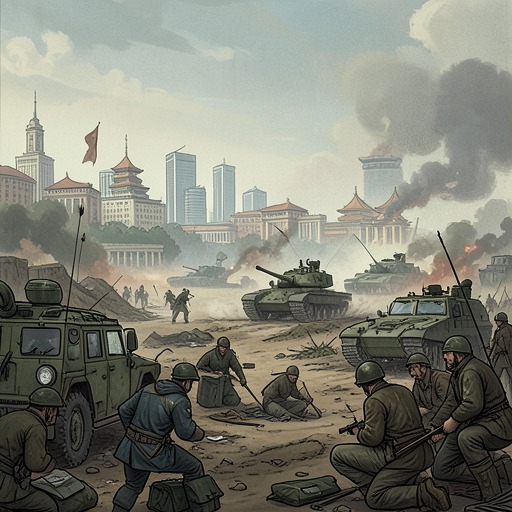
The alliance’s military presence also appears in the account of the assault on Luanda from the north. The attack involved armoured vehicles and artillery, companies of Zairian troops, and Portuguese mercenaries. This is a concrete instance of the support described in the strategic plan: Zairian forces were not merely associated with the FNLA in political language but were reported as participating in an armed advance toward the capital.
At the same time, the book’s other front-line episodes emphasize how uncertain military power could be in practice. The MPLA’s forces faced shortages of ammunition, fuel, transport, and water; in Caxito, the FNLA’s defeat left prisoners to be questioned by the MPLA’s political commissar, Comandante Ju-Ju. These details do not measure the alliance’s full resources, but they place its operations against a war in which logistics, local conditions, and shifting control could matter as much as the plan on paper.
Competing Claims and the View from Luanda
The alliance also entered the war as a message directed at civilians. In September, an unmarked black plane dropped leaflets claiming that Holden Roberto’s army was outside Luanda and would soon enter the capital. The leaflets urged people to kill Russians, Hungarians, and Poles said to be commanding MPLA units. The narrator notes that he was the only person from Eastern Europe in Angola at the time, making the threat personal as well as political. The episode shows how the prospect of an FNLA advance was framed to inspire fear and turn the city’s population against people associated with the MPLA.
Later, Holden Roberto announced that he would enter Luanda and called on the population to remain calm. His leaflets presented him beneath the claim that God ruled in heaven and he ruled on earth. The words offered a stark image of authority, but they appeared in a city already shaken by artillery and uncertainty. The narrator’s account sets such public declarations beside the physical proximity of the front, where the approach of an army was not an abstract contest over legitimacy.
MPLA communications supplied a counterpoint. Comandante Ju-Ju’s radio communiqués, the narrator observes, were brief and calm when events were going well but became longer and more self-praising when the situation worsened. Later, despite the narrator’s assessment that half the country was in enemy hands, Ju-Ju’s daily communiqué remained very optimistic. These broadcasts do not independently verify the alliance’s strength or its battlefield fortunes; rather, they reveal how each side’s claims shaped what civilians could believe about the war.
Significance and Limits of the Evidence
Across these episodes, the Zaïre–FNLA alliance has three distinct forms: political backing for Roberto’s movement, a reported role for Mobutu’s troops in recruiting Angolan Bakongos in Kinshasa, and the participation of Zairian army units in the northern and eastern coalition forces. The book also identifies Zairian troops in the assault from the north. Together, those details connect cross-border support to the attempt to capture Luanda and determine the government that would take power at independence.
The account does not supply a complete record of the alliance’s command structure, the scale of its aid, or the decisions made by its leaders. Its evidence comes instead through a strategic outline, a prisoner’s testimony, descriptions of forces, and the competing messages heard in wartime Luanda. That unevenness matters: the alliance emerges not as a single, fully documented institution, but as a relationship made legible through its consequences—who was recruited, which forces advanced, and what the population was told to expect.